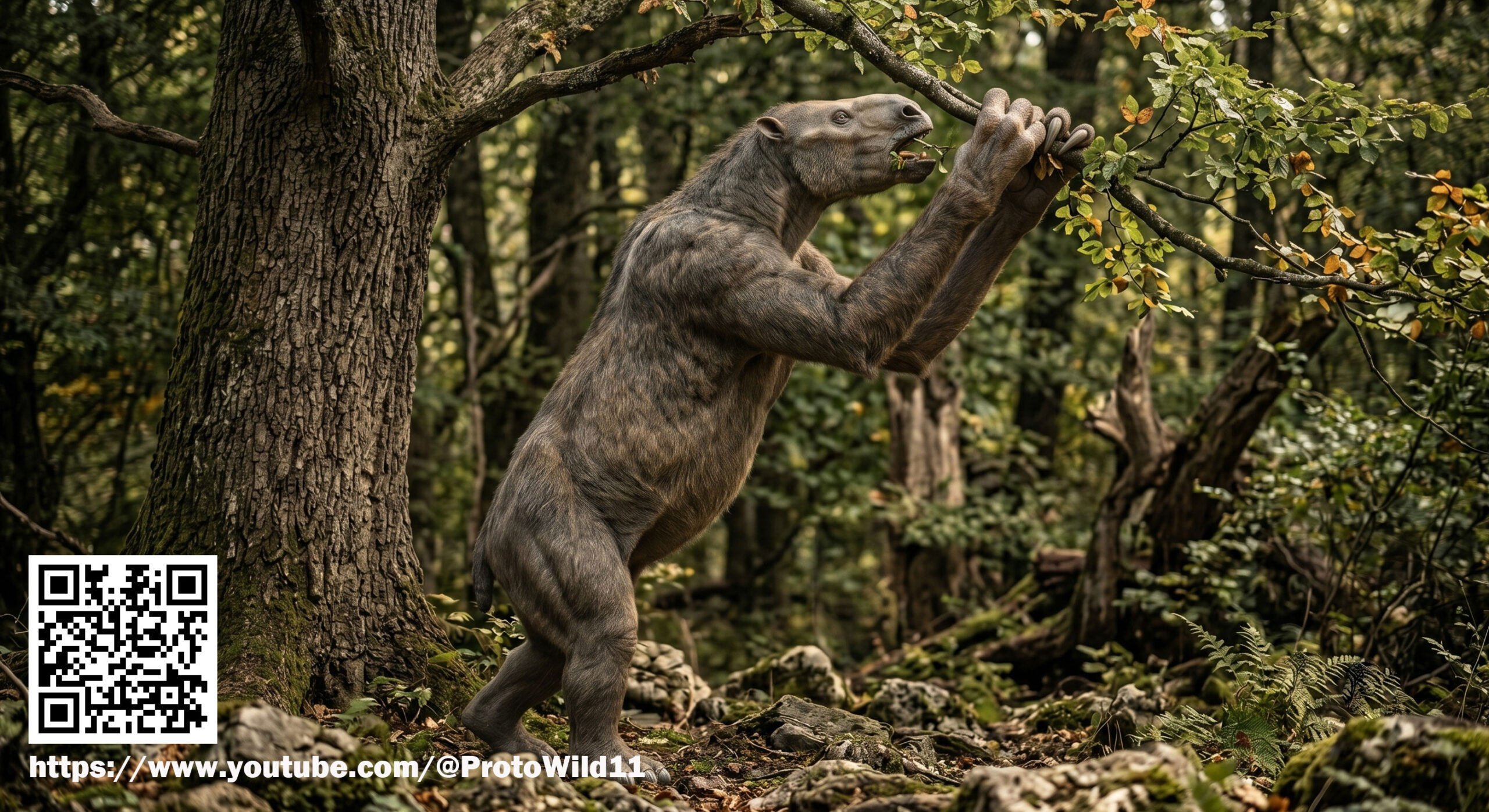

Roaming the ancient forested environments of Eurasia and Africa from the Oligocene through the Pliocene epochs, Chalicotherium represents one of the most bizarre evolutionary experiments among ungulates. Weighing over a ton and standing over two meters tall at the shoulder, this heavy herbivore combined equine-like head traits with gorilla-like forelimbs and hooked claws, setting it completely apart from any modern hooved mammal.
Discover our technical restoration workflow as we evaluate the unique physical adaptations of this extraordinary herbivore and break down the complex technical challenges behind rendering its unusual locomotion in 16K ultra-high-definition video with complete realism.
▶ Click the YouTube link below to watch the vivid, restored 16K ultra-high-definition video
A Unique Anatomical Paradigm Among Ancient Ungulates
Despite being a relative of modern horses, tapirs, and rhinoceroses, Chalicotherium evolved a highly specialized body structure adapted for browsing high foliage in primeval forests.
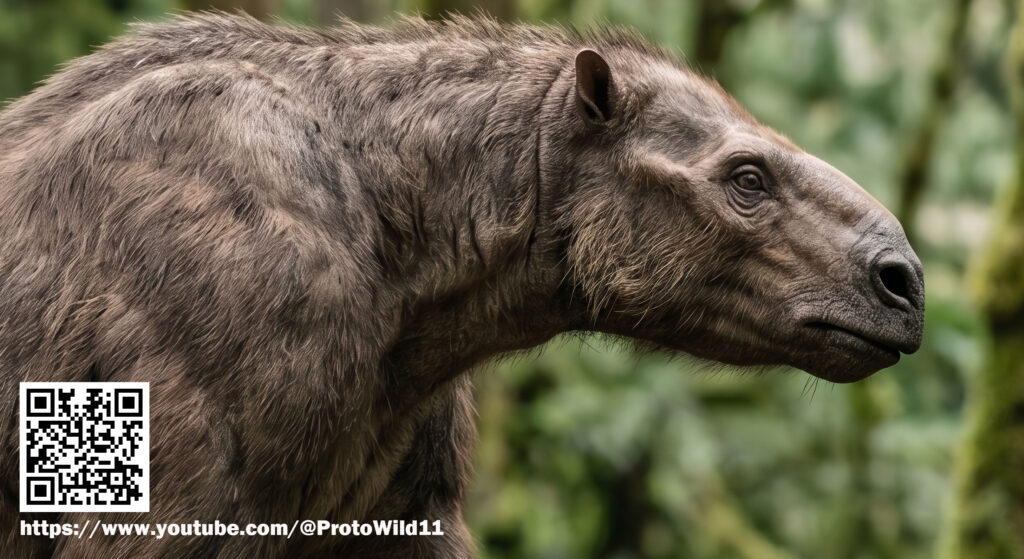
- Horse-Like Skull and Herbivorous Dentition Chalicotherium featured an elongated, deep skull similar to a primitive horse, with high-set eyes and a muscular upper lip. Its dentition was exclusively adapted for grinding soft leaves and twigs, featuring broad molars and completely lacking sharp canine teeth or tearing tusks.
- Powerful Forelimbs Built for Knuckle-Walking Unlike typical ungulates that walk on hooves, Chalicotherium possessed long, heavily muscled front legs combined with shorter hind limbs. It walked by curling its front claws inward, bearing its weight on its knuckles—a distinct knuckle-walking gait similar to modern gorillas.
- Specialized Large Curved Claws for Feeding Instead of hooves, each foot of Chalicotherium ended in a set of three strong, curved claws. These specialized claws were not used for catching prey, but for hooking down high tree branches to pull leafy boughs closer to its mouth while sitting or standing on its hind legs.
The Struggle of AI Digital Restoration
Bringing Chalicotherium to life in a realistic 16K video was by far the most difficult and complex technical challenge in our entire digital restoration project. The AI struggled continuously because the creature’s hybrid morphology completely broke standard biological training datasets.
From the initial modeling phase, establishing the base anatomy was exceptionally hard. The AI constantly distorted the skull geometry, repeatedly turning the horse-like head into a primate or monkey face. Furthermore, while rendering the claws, the AI repeatedly sprouted an absurd number of extra digits—randomly adding 4, 5, or more claws per foot—or exploding the claw size into oversized, fantasy-style weapons. Every time the creature opened its mouth to browse on leaves, the model erroneously generated sharp, predatory canine teeth inside its mouth.
The absolute hardest part of the entire project was animating the signature knuckle-walking gait. As Chalicotherium moved through the forest, the AI failed to maintain the complex weight-bearing knuckle stance, constantly morphing the front limbs into flat horse hooves or primate hands while shifting the claw count and growing long teeth during feeding cycles. To overcome these persistent glitches, we applied strict frame-by-frame temporal locks to stabilize the horse-like skull, exact three-claw foot count, canine-free herbivorous jawline, and natural knuckle-walking locomotion throughout the sequence.

The Final Prompt for Perfect Realism
To block the AI from creating a fake, video-game-style animal, we used this highly detailed prompt. It ensures the true anatomy, horse-like head, precise three claws, and stable knuckle-walking gait of Chalicotherium stay intact while moving.
[AI Generation Prompt] 16K RAW footage, an ultra-realistic giant prehistoric ungulate Chalicotherium walking with a heavy, deliberate knuckle-walking gait across a sun-lit Miocene forest floor. [Anatomy & Limb Lock] Large mammal with long, powerful front legs and shorter hind legs, sitting high at the shoulders. Head is distinctly ELONGATED AND HORSE-LIKE; STRICTLY NO monkey face, NO primate features, NO ape skull. Front feet are folded inward, bearing weight on knuckles; STRICTLY PERFECT KNUCKLE-WALKING GAIT. Each foot features EXACTLY THREE large, curved, hooked claws; ABSOLUTELY NO extra claws, NO random digit count, NO giant fantasy claws, NO horse hooves. [Feeding & Jaw Lock] As it reaches up to pull down a leafy branch, its mouth opens showing ONLY broad herbivorous grinding teeth; STRICTLY NO sharp canine teeth, NO predatory tusks, NO long sharp teeth. Short brown coarse fur coat. [Motion Lock] Temporal consistency lock during motion: the horse-like head shape, exact three-claw foot geometry, canine-free jawline, and knuckle-walking stance must remain completely locked without turning into a monkey face, sprouting extra claws, growing canine teeth while eating, or flattening into hooves. Ultra-realistic fur texture, dry leaves crunching under knuckles, warm sunlight filtering through forest canopy. Natural shallow depth of field blurring background trees. Ambient forest wind with heavy stepping sounds, majestic cinematic background music. Negative Prompt: monkey, ape, primate face, human-like face, horse hooves, flat feet, extra claws, random digits, 4 claws, 5 claws, giant oversized claws, canine teeth, sharp teeth, tusks, predatory mouth, bipedal walking, morphing claws, warping legs, changing head shape, plastic texture, CGI style, video game graphics, artifact blur.
Uncovering the extraordinary anatomical truths of extinct mammalian lineages deepens our understanding of ancient forest ecosystems and preserves the legacy of Earth’s lost fauna